 |
| H.E President Gustavo Petro Urrego |
"Arriving here, next to this sword, for me is a whole life, an existence. This sword represents too muchfor us.
And I want it never to be buried, I want it never to be held back.
May it only be sheathed, as its owner, the Liberator, said, when there is justice in this country.
May it belong to the people. It is the sword of the people.
And that is why we wanted it here at this moment and in this place. Perhaps for the next presidents,
when they take office, it will become a permanent, protocol, symbolic fact, that will always accompany
them, the libertarian sword of Bolivar.
To arrive here undoubtedly implies to travel a life. The immense life that is never traveled alone.
Here is my mother, Clara. Nothing would exist in me, at this moment, without her.
Here is my father, Gustavo, Caribbean. Here are my siblings Adriana and Juan, who put up with me and
still put up with me.
Here are my children, Nicolás Petro, Nicolás Alcocer, Andrea and Andrés, Sofía and Antonella, my little
ones who blossom in heart and soul.
Here is Veronica Alcocer, who has accompanied me, who has given me offspring, life itself. Who love
has made everything possible.
Here she is not only to accompany me but to accompany the women of Colombia in their efforts to
move forward, to create, to fight, to be. To overcome violence inside and outside the families, to build
the politics of love.
Here, as in the course of my existence, are the people. The humble hands of the worker. Here are the
peasant women and those who sweep the streets. Here are the hearts of labor, the illusions of those
who suffer, here are the working women who have always embraced me when I decay, when I feel
weak, the love for the people, for the excluded people who suffer, it is that love that keeps me here to
unite and build a nation now.
Thus ended One Hundred Years of Solitude by our beloved Gabriel García Márquez: "Everything written
in them was unrepeatable from always and forever, because the lineages condemned to one hundred
years of solitude did not have a second chance on earth".
We Colombians have been sent many times in our history to the condemnation of the impossible, to
the lack of opportunities, to the resounding NO. I want to tell all Colombians who are listening to me in
this Plaza de Bolivar, in the surrounding area, throughout Colombia and abroad, that today begins our
second chance.
 |
| H.E Gustavo and his Vice Presiudent,Francia Márquez |
We have earned it. They have earned it. Their effort was and will be worth it. It is time for change. Our
future is not written. We own the pen and the paper, and we can write it together, in peace and unity.
Today begins the Colombia of the possible. We are here against all odds, against a history that said we
were never going to govern, against the usual, against those who did not want to let go of power. But
we did it. We made the impossible possible. With work, traveling and listening, with ideas, with love,
with heart and brain, with effort. From today we begin to work so that more impossible things are
possible in Colombia. If we could, we can.
May peace be possible. We have to put an end, once and for all, to six decades of violence and armed
conflict. I would say with two centuries of permanent war, the eternal war, the perpetual war of
Colombia. It can be done.
We will comply with the Peace Agreements, we will follow to the letter the recommendations of the
Truth Commission's report, which counts the number of deaths, depending on the date we start
counting. When the Truth Commission began to count, it counted 800,000 deaths caused by violence
to date. Dead Colombians, dead Colombian women, most of them humble. We cannot continue in the
country of death, we have to build the country of life.
And we will work tirelessly to bring peace and tranquility to every corner of Colombia. This is the
government of life, of peace, and it will be remembered as such.
Peace is possible if we unleash social dialogue in all regions of Colombia, to meet in the midst of
differences, to express ourselves and be heard, to seek through reason, the common paths of
coexistence. It is society as a whole that must dialogue on how not to kill each other and on how to
progress.
In the binding regional dialogues, we summon all unarmed people, to find the paths in the territory that
allow coexistence. It does not matter what conflicts there are. It is precisely a matter of showing them
through words, of trying to find solutions through reason. It is more democracy, more participation that
I propose to put an end to violence.
But we also call on all the armed groups to lay down their arms in the mists of the past. To accept legal
benefits in exchange for peace, in exchange for the definitive non-repetition of violence, to work as
owners of a prosperous but legal economy that puts an end to the backwardness of the regions.
For peace to be possible in Colombia, we need to dialogue, to dialogue a lot, to understand each other,
to look for common paths, to produce changes.
Peace implies that we change, undoubtedly. Of course, peace is possible if we change, for example, the
policy against drugs, seen as a war, called the war against drugs, for a policy of strong prevention of
consumption in developed societies.
It is time for a new International Convention that accepts that the war on drugs has failed utterly, that
it has left one million Latin Americans murdered, mostly Colombians, during these last 40 years, and
that it leaves 70,000 North Americans dead from drug overdoses every year, none of which are
produced in Latin America. That the war on drugs has strengthened the mafias and weakened the
States.
That the war on drugs has led States to commit crimes - our State has committed crimes - and has
evaporated the horizon of democracy.
Are we going to wait for another million Latin Americans to be murdered and 200,000 overdose deaths
per year in the United States? Are we going to wait for another million Latin Americans to be murdered
and 2,800,000 Americans to die from overdoses in the next 40 years?
Or do we exchange failure for a success that will allow Colombia and Latin America to live in peace?
The time has come to change the anti-drug policy in the world so that it allows life and does not generate
death. That they want to support us in peace, they tell us again and again in all the speeches. Well,
change the anti-drug policy, it is in your hands, in the world power, in the United Nations, to be able to
do it.
Let equality be possible. 10% of the Colombian population has 70% of the wealth. It is a nonsense and
it is a true amorality. Let us not naturalize inequality and poverty.
It is not true that the world is equal, it is not true that in most of the countries of the world this social
inequality that we have in Colombia exists. We are one of the most socially unequal societies on planet
earth. And this is an aberration that we cannot continue if we want to be a nation, if we want to live in
peace.
Let us not look the other way, let us not be accomplices. With will, redistribution policies and a program
of justice we will make Colombia more egalitarian and with more opportunities for all.
Equality is possible if we are capable of creating wealth, of generating wealth for all, and if we are
capable of distributing it more fairly.
That is why we propose an economy based on production, work and knowledge. And that is why we
propose a tax reform that generates justice. Taking a part of the wealth of the people who have the
most and earn the most, to open the doors of education to all children and youth, should not be seen
as a punishment or a sacrifice. It is simply the solidarity payment that someone fortunate makes to a
society that allows and guarantees his fortune.
If we are able to bring a part of the wealth that is created, to malnourished children, through something
as simple as paying taxes, we will be fairer and we will be more at peace. It is not only a matter of charity,
it is a matter of human solidarity. Solidarity is what has allowed peoples to survive and achieve the
greatest conquests of culture and civilization.
We have not advanced as humanity by competing, that is not true; we have done it by helping each
other. That is why we are alive on this planet. We will be equal when the one who has more, when
paying his taxes, does it with pleasure, with pride, knowing that he will help his neighbor boy, girl, baby,
young man, woman, to grow healthy, to think, to live with the fullness that gives nutrition and education
of the brain and soul.
Solidarity is in the tax paid by those who can afford it and in the State spending that goes to those who
need it for their childhood, their youth, their old age. State spending is not for the political mafias, it is
for the people.
That is why we have proposed a tax reform, a health and pension reform, a reform of the labor contract,
an education reform. That is why we have prioritized in the budget the infrastructure of education,
health, drinking water, irrigation districts and local roads.
Taxes will not be confiscatory, they will simply be fair, in a country that must recognize as an aberration
the enormous social inequality in which we live, in a State that must protect the transparency of
spending, and in a society that deserves the right to live in peace.
To be a knowledge society, that is, a society where all its members have the highest level of education
and culture, is not a utopia. Peoples poorer than us decades ago, are now knowledge societies only
because they invested for decades and with priority in the public education of their peoples.
The time has come to repay the debt to our public education so that it reaches everyone and is of
quality.
The time has come to be aware that today hunger is advancing. It is advancing throughout the world,
because the idea of food security based exclusively on international trade has collapsed. International
trade in itself is neither positive nor negative, but if it is not managed intelligently and planned, it can
destroy economies and lives.
The world today is learning the importance of food sovereignty. Food sovereignty is the guarantee that
every society must have to consume its indispensable nutrients. Colombia is a country that must and
can enjoy food sovereignty to achieve zero hunger. A mission of the State with all the private sector that
wants to join must guarantee the full healthy nutrition of the entire Colombian society and even achieve
surpluses for export.
In the land where human beings discovered corn, we must produce corn again. The State will have to
provide irrigation, credits, techniques, improved seeds, protection; the peasantry and private enterprise
can provide the work and daily commitment to ensure that our fields once again produce the food that
our people need.
We will again build irrigation districts with the Army and peasant houses and roads with the soldiers of
the homeland.
Army, society and production can unite in a new indestructible social ethic. Helicopters and airplanes
and frigates, not only serve to bomb or shoot; they also serve to create the first infrastructure for the
preventive health of the Colombian people.
Only if we produce will we be rich and prosperous as a society. Wealth is in work and work is more and
more, of intelligence.
That is why, as of today, all the assets of the SAE in extinction of the rights of property or extinguished,
will become the basis of a new productive economy administered by peasant organizations, by urban
cooperatives of productive young people and by popular women's associations.
Let gender equality be possible. We cannot continue to allow women to have fewer job opportunities
and earn less than men, to have to dedicate three or four times as many hours to care work, to be less
represented in our institutions. It is time to fight all these inequalities and balance the scales.
Let the green future be possible. Climate change is a reality. And it is urgent. Neither the leftist nor the
rightist says so, the science says so. We have and can find a model that is economically, socially and
environmentally sustainable.
There will only be a future if we balance our lives and the world's economy with nature. Science has
announced the possible extinction of the human species in just one or two centuries due to the health
effects of the climate crisis. One or two centuries are left.
The covid virus showed the whole of humanity the real and living warning of this possibility.
Science does not seem to be wrong. That is why from this Colombia we ask the world for action and not
hypocrisy.
We are willing to move to an economy without coal and oil, but we do little to help humanity with it.
We are not the ones who emit greenhouse gases. It is the rich of the world who do it, bringing human
beings closer to extinction, but we do have the largest absorption sponge of these gases after the
oceans: the Amazon rainforest.
One of the pillars of climate balance and life on the planet is the Amazon rainforest. Are we going to let
this rainforest be destroyed to reach the point of no return in the extinction of humanity? Or, are we
going to save it with humanity itself that wants to continue living on this earth?
Where is the world fund to save the Amazon rainforest? Speeches will not save it. We can convert the
entire population that today inhabits the Colombian Amazon into a population that cares for the
rainforest, but we need the world's funds to do it.
If it is so difficult to get those monies, that the carbon taxes, that the green bonds, that the agreed
climate funds should grant to save something so essential, then, I propose to humanity to change
external debt for internal expenses, to save and recover our jungles, forests and wetlands. Decrease the
external debt and we will spend the surplus to save human life.
If the IMF helps to exchange debt for concrete action against the climate crisis, we will have a new
prosperous economy and a new life for humanity.
No more "it can't be done", no more "it has always been this way". Today begins the Colombia of the
possible. Today begins our second chance.
From today, I am the President of all Colombians. It is my desire and my duty.
Colombia is not only Bogotá. The government of change will be decentralized. I promise you that we
will be and work throughout the country, from Leticia to Punta Gallinas, from Cabo Manglares to Isla
San José. The absence of the State in many parts of the country hurts a lot. No more. I am going to work
so that the place of birth does not condition your future and so that the State is present in every corner
of Colombia.
I am grateful for the presence of presidents, and other representatives of the brotherly peoples of Latin
America and the whole world. In times when we see sister nations bombing, killing and riddling each
other, here, in the heart of Colombia, in the heart of Latin America, there are a dozen presidents of the
region, with ideological diversity and different backgrounds, but all united, sharing this true celebration
of democracy.
It is time to leave behind the blocs, groups and ideological differences to work together. Let us
understand once and for all that what unites us is much more than what separates us. And that together
we are stronger. Let us realize the unity that our heroes, such as Bolivar, San Martin, Artigas, Sucre and
O'Higgins, dreamed of. It is not a utopia nor is it romanticism. It is the way to become strong in this
complex world.
If we are the power of knowledge, if we are the power of the economy, if we are the power of life, if we
act together, the voice of Latin America will be heard in the concert of the peoples of the world.
Today we need to be more united than ever. As Simón Bolívar once said: "Union must save us, just as
division will destroy us if it is introduced among us". Let there be an end to the division of Latin America.
But Latin American unity cannot be a rhetoric, a mere discourse. We have just lived through perhaps
the worst of the covid pandemic, and Latin America was not able to come together, to coordinate, to
buy the cheapest vaccines, it was practically used without negotiation capacity, dispersed in its
governments.
Are we going to have a Latin America with no capacity for scientific research, a Latin America with no
capacity to coordinate its health services, with no capacity to coordinate the purchase of medicines in
a unified manner?
Latin America is united in some institutions, but not in concrete projects. Have we achieved the
connection of all our electric energy networks? Is there an electric energy network that covers all
America? Have we achieved that the sources of our energies are clean? Is it not time to encourage the
public oil companies, state-owned, and our electric transmission companies to build the Latin American
business and financial instrument that will encourage investments in the generation of clean energies
and in the transmission of that energy on a continental scale?
Colombia will make its international emphasis on reaching the most ambitious agreements possible to
curb climate change and defend world peace. We do not want any country to invade another.
We are not for war. We are for Life.
We will seek greater alliances with Africa where we come from, we will seek an alliance of African
peoples in America, we will seek that San Andres be a health, cultural and educational center of the
Antillean Caribbean; from there, from San Andres, from its Raizal people, will come all the ambassadors
of Colombia for the Antilles.
We will seek an alliance with the Arab world on the road to move towards the new decarbonized
economies. We will seek to join our Buenaventura and our Tumaco with the rich and productive East
Asia.
Our anthem, which is one of the most beautiful in the world, says "feel or suffer". Colombia accumulates
centuries of suffering. A mother who cannot feed her child suffers it. A young man who emigrates
because he cannot find opportunities, suffers it. A grandmother or grandfather who does not have a
decent pension, suffers from it. The Colombia we dream of, the Colombia we want, the Colombia we
deserve is the Colombia we want to feel. The Colombia that vibrates, that strives, that yearns and works
to achieve peace. That wants a prosperous land, with equal possibilities regardless of where you were
born, regardless of your parents' surname or the color of your skin. That is the Colombia we want to
feel and for which we will work until the last day of our mandate.
Decalogue of Government
In this first speech as President of Colombia, before the Legislative Branch and before my people, I
would like to share my government decalogue and my commitments.
I have 10 commitments:
1. I will work to achieve true and definitive peace. Like no one else, like never before. We will
comply with the Peace Agreement and follow the recommendations of the Truth Commission's
report. The "Government of Life" is the "Government of Peace".
Peace is the meaning of my life, it is the hope of Colombia.
We cannot fail Colombian society. The dead deserve it. The living need it. Life must be the basis of peace.
A just and safe life. A life to live tasty, to live happy, so that happiness and progress are our identity.
2. I will care for our grandfathers and grandmothers, for our children, for people with disabilities,
for people whom history or society has marginalized. We will make a "policy of care" so that NO
ONE is left behind. We are a caring society that cares and cares for others.
Let your government be so too. We will make a policy sensitive to the suffering and pain of others, with
tools and solutions to create equality.
3. I will govern with and for the women of Colombia. Today, here, begins a parity government with
a Ministry of Equality. Finally! With our Vice President and Minister Francia Márquez we will
work so that gender does not determine how much you earn or how you live. We want real
equality and security so that Colombian women can walk in peace and not fear for their lives.
4. I will dialogue with everyone, without exceptions or exclusions.
This will be an open-door government for anyone who wants to discuss Colombia's problems. Whatever
his or her name is, wherever he or she comes from. The important thing is not where we come from,
but where we are going. We are united by the will for the future, not by the weight of the past.
We are going to build a Great National Agreement to set the roadmap for Colombia in the coming years.
Dialogue will be my method, agreements my objective.
5. I will listen to Colombians as I have been doing in all these years. I will NOT govern at a distance,
far from the people and disconnected from their realities. On the contrary, we govern by
listening. We are going to design mechanisms and dynamics so that all Colombians feel heard
in this Government. I will not be trapped in the curtains of bureaucracy. I will be close to the
problems.
I will walk beside and together with Colombians from all corners of the country. I hope they will open
their houses to me to sleep, like the coffee farmer of Anserma, like the poor lady of Quibdó, like the
fisherman of the Magdalena River in Tolima.
Only those who are close can understand and put themselves in the place of the other.
6. I will defend Colombians from violence and I will work to make families feel safe and calm.
We will do it with a comprehensive security strategy. With human security. Colombia needs a strategy
that goes from prevention programs, from social redemption, from ending hunger, to the persecution
of criminal structures and the modernization of the security forces. Lives saved will be our main indicator
of success. Security is measured in lives, not deaths. When security is measured in deaths, they lead the
State to crime and this State is not for heinous crime. This State is there to be a social state under the
rule of law.
Crime is fought in many ways. All of them are essential. I want to defend Colombian families from daily
and routine insecurity: be it from male violence or any other violence.
7. I will fight corruption with a firm hand and without mercy. A government of "zero tolerance".
We will recover what was stolen, we will be vigilant so that it does not happen again and we will
transform the system to discourage this type of practices. Neither family, nor friends, nor
colleagues, nor collaborators... no one is excluded from the weight of the Law, from the
commitment against corruption and from my determination to fight against it.
From now on, the State intelligence corps will not persecute the political opposition, nor the free press,
nor the Judiciary, nor those who think differently.
Today the main objective of the State intelligence corps is to locate and fight corruption.
8. I will protect our soil and subsoil, our seas and rivers. Our air and sky. Our landscapes define us
and fill us with pride. And, for that reason, I will not allow the greed of a few to put our
biodiversity at risk. We will confront the uncontrolled deforestation of our forests and promote
the development of clean and renewable energies. Colombia will be a world power of life.
Planet Earth is the "common home" of human beings. And Colombia, from its enormous natural
wealth, will lead this struggle for planetary life.
9. I will develop national industry, the popular economy and the Colombian countryside.
We will give priority to peasant women, to women of the popular economy, undoubtedly; to the micro-
entrepreneur and the small and medium entrepreneur of Colombia. But our invitation is to produce, to
work, to be aware that we will only be a rich society if we work.
And that work, more and more, in the 21st century, is a property of knowledge, of the brain, of human
intelligence.
We will accompany and support all those who make an effort for Colombia. The farmer, the peasant,
who rises at dawn. The artisan, the craftsman, who keeps our culture alive. The businessman, the
businesswoman, who creates work. The cultural worker who builds human sensitivity.
Science, culture and knowledge are the fuel of the 21st century. Let us develop the society of knowledge
and technology.
10. I will fulfill and enforce our Constitution. The one that says in its Article 1: "Colombia is a social
State under the rule of law, organized as a unitary, decentralized Republic, with autonomy of
its territorial entities, democratic, participatory and pluralistic, founded on respect for human
dignity, on the work and solidarity of the people who make it up and on the prevalence of the
general interest".
We will also develop a new legal framework to make our development sustainable, fair and egalitarian.
The law, as Paolo Flores d'Arcais says, is the power of those who have no power. We need better laws,
new laws at the service of the great majorities and to guarantee their compliance.
I am very confident that the debates in our Congress of the Republic will be fruitful and offer results for
Colombian society.
There are many tasks and I have full confidence in our representatives of Colombian society in Congress.
New and old.
And finally, I will unite Colombia. We will unite, among all of us, our beloved Colombia. We have to say
enough to the division that confronts us as a people. I do not want two countries, just as I do not want
two societies. I want a strong, just and united Colombia.
The challenges we face as a nation demand a period of unity and basic consensus. This is our
responsibility.
I end here with what an Arhuaca girl told me three days ago, in the ancestral possession ceremony we
held on Friday in the heart of the world, as the children of the Sierra Nevada de Santa Marta call it: "To
harmonize life, to unify the peoples, to heal humanity, feeling the pain of my people, of my people here,
this message of light and truth, spread through your veins -she told me-, through your heart and become
acts of forgiveness and world reconciliation, but first, in our hearts. First in my heart. Thank you.
This second opportunity is for her, the Arhuaca girl, for all the children of Colombia."



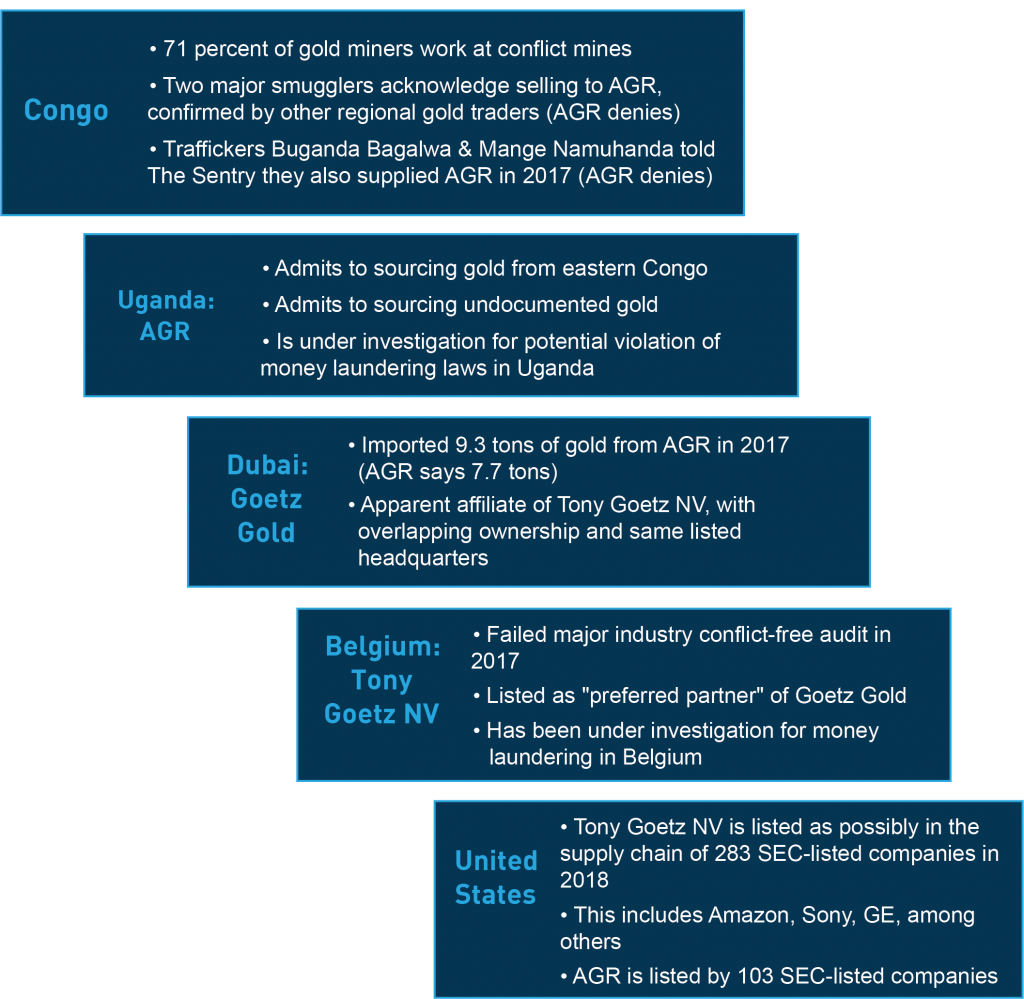 Editor’s Note: Following the initial publication of this report, The Sentry has become aware of news reports indicating that, in addition to AGR, two additional companies may have recently received licenses to operate gold refineries in Uganda.


